How to Choose a DC Fast Charging Station in 2026?
Choosing a Dc Fast Charging Station in 2026 means matching the equipment to real charging needs, not just comparing headline power ratings. A station rated at 300 kW may not deliver that speed to every vehicle. Battery temperature, state of charge, vehicle limits, and shared power can all affect charging time. Check the connector types and charging standards supported by the vehicles expected to use the site. Compatibility should be confirmed against manufacturer specifications, not inferred from a product photo.
Look beyond peak power. Review the station’s operating range, network connectivity, payment options, warranty, and access to technical support. For a commercial site, ask an electrical professional to assess available capacity, expected demand, and installation requirements before choosing a model. A charger is only useful when the site can support it reliably. Request service-response details and uptime reporting, and ask how software updates are handled. Small details matter.
Compare the total cost of ownership, including installation, maintenance, network fees, and possible capacity upgrades. Ask suppliers for documentation and references from installations with similar usage. Then compare their answers in writing. A polished specification sheet cannot guarantee dependable service, and a low purchase price may leave important costs unclear. There is no perfect checklist; site conditions and driving patterns vary, and forecasts can be wrong. That uncertainty deserves attention, not a sales promise. The right choice is the station whose verified capabilities fit your vehicles, location, budget, and maintenance plan.
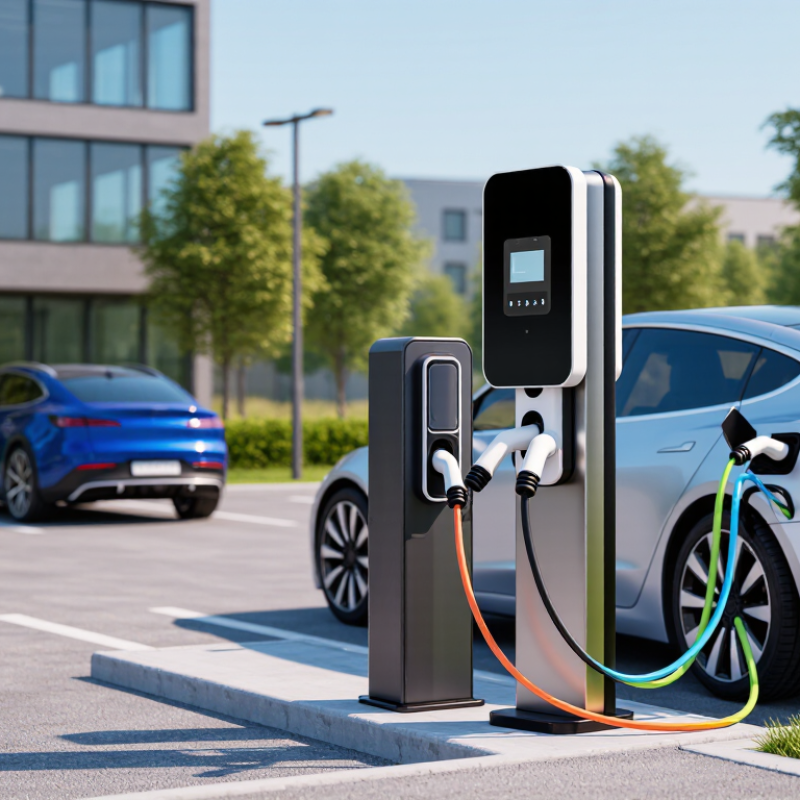
Match Vehicle Compatibility: CCS1, CHAdeMO, and SAE J3400 Connectors
Choosing a DC fast charging station in 2026 starts with the inlet on your vehicle, not the shape of a nearby charger. Check the owner’s manual or vehicle specifications for the exact connector and supported charging method. A plug that fits is not always enough; the vehicle and station must also communicate correctly.
CCS1 remains a common DC fast charging connector in North America. CHAdeMO is used by some vehicles, but station availability can vary by location. SAE J3400 describes the connector commonly known as NACS; newer vehicles may support it directly, while others may require an approved adapter. Confirm that any adapter is rated for DC fast charging and supported for your specific vehicle. Small details matter.
Before driving across town, filter charging locations by connector and check recent station status. Look closely at the cable, too: a station may offer several plug types, but not every post has every connector. Compatibility listings can be confusing, and a connector photo alone is weak evidence. I would verify the vehicle’s requirements and the station’s available cable before relying on a charging stop.
Compare Charger Output with Vehicle Limits: 50–350 kW and 400/800 V
How to Choose a DC Fast Charging Station in 2026?
A charger’s rated output is a ceiling, not a promise. The U.S. Department of Energy’s Alternative Fuels Data Center classifies DC fast charging as equipment generally delivering 50 kW or more. Stations may advertise 50–350 kW, but your vehicle’s battery, temperature, and state of charge determine what it actually accepts. Check the vehicle manual for its peak charging power and the conditions needed to reach it. A 350 kW unit may add no speed if your car tops out at 100 kW. That matters.
Voltage compatibility deserves equal attention. Many vehicles use 400 V battery systems; some newer models use 800 V systems to support higher-power charging with suitable equipment. An 800 V car cannot automatically draw 350 kW, and a station’s voltage range can affect compatibility and performance. Confirm the charger’s supported voltage and the vehicle’s charging specifications before choosing a stop. The International Energy Agency’s Global EV Outlook 2024 reported that public fast-charging points grew by about 55% in 2023, reaching roughly 1.3 million worldwide. More plugs are appearing, but the labels can still be confusing. I would compare vehicle limits first, then check live availability and recent charger performance. A neat number on a cabinet can still disappoint.
Evaluate Network Features: OCPP 2.0.1, Uptime Reporting, and Roaming
When comparing DC fast charging stations in 2026, ask how the network handles OCPP 2.0.1, not just whether it lists support. The protocol can support device management, diagnostics, and security features, but results depend on implementation and backend configuration. Request a live demonstration: remotely reset a charger, inspect a fault code, and confirm the event appears in the operator dashboard. Small test. Also ask who manages software updates and checks compatibility after firmware changes.
Uptime reporting needs a clear definition. Does a station count as available when it is online but its connector cannot start a session? Review monthly records by charger and connector, including outages, maintenance windows, failed starts, and repair times. Look for timestamps and downloadable data, not only a green percentage. A 98% figure can hide repeated evening failures at a busy site. Compare reports with a site visit or test sessions; dashboards help, but they do not tell the whole story.
Roaming matters when drivers use different charging apps or payment methods. Check which roaming protocols and settlement processes are supported, then verify that prices, session status, and receipts stay consistent across networks. Try a cross-network session before signing. Ask how support teams trace failed authorizations or delayed payments. It gets messy. Some cases may still need manual follow-up, so clarify response times and escalation steps in writing. A capable station must also be easy for drivers to find, start, and pay for.
Calculate Costs and Site Capacity: kWh Rates, Demand Charges, and NEC 625
Choosing a DC fast-charging station in 2026 starts with the bill, not the charger’s headline power. A site may pay per kilowatt-hour (kWh), plus a monthly demand charge tied to its highest measured power draw. That spike matters. It can come from several vehicles charging together. Check the utility tariff’s billing interval, demand rates, and time-of-use periods before estimating operating costs. For a rough example, a 150-kW charger running at full output for 20 minutes could deliver up to 50 kWh, before charging losses or power tapering. Multiply delivered energy by the kWh rate, then model peak demand separately. Keep assumptions visible.
Compare that estimated load with the electrical service, transformer capacity, and other site demand. Two 150-kW dispensers may not need 300 kW of simultaneous supply if managed charging limits output, but lower power can increase waiting times. Estimate arrival patterns, charging duration, and seasonal building loads. My first estimate would still be imperfect; real traffic rarely follows a neat spreadsheet. NEC 625 covers EV power transfer equipment and installation requirements. Confirm the locally adopted edition and site-specific requirements with a qualified electrical professional and the authority having jurisdiction. Request a load calculation and utility service review before selecting equipment, and allow for future expansion.
Check Safety and Accessibility: UL Certification and ADA Requirements
How to Choose a DC Fast Charging Station in 2026?
Check Safety and Accessibility: UL Certification and ADA Requirements
A charger should feel safe before it feels fast. Check its certification label and confirm the installed model matches the documentation. UL 2202 covers electric-vehicle charging systems; UL 2231-1 and UL 2231-2 address personnel protection. These standards do not replace a site inspection, but they give buyers concrete safety checks.
Accessibility deserves equal attention. The CDC’s Disability and Health Data System reports that about one in four U.S. adults has a disability. Look for a step-free route, clear space beside the charger, readable screen text, and controls reachable from a seated position. The U.S. Access Board’s recommendations for accessible EV charging stations offer useful design guidance. ADA obligations can depend on the facility and applicable rules, so verify requirements for the specific site.
Try the station in person, if possible. Can a wheelchair user approach without crossing a cable? Is the connector manageable, and can the screen be read in direct sunlight? Small details matter. A quick curbside glance can still miss a poor reach range. I would not treat a certification mark as proof that every user can charge comfortably; installation and maintenance matter, too.
How to Choose a DC Fast Charging Station in 2026: Check Safety and Accessibility
ADA baseline dimensions for planning accessible routes and parking areas
What this means: These dimensions come from the 2010 ADA Standards and are general accessibility benchmarks, not EV-charger-specific federal siting dimensions. Check applicable local requirements and site conditions. For equipment safety, review the product’s certification scope, including applicable UL 2202 and UL 2231 standards.
Source: 2010 ADA Standards for Accessible Design, Sections 403.5.1, 502.2, and 502.3. Dimensions shown are minimum clear widths or diameter.